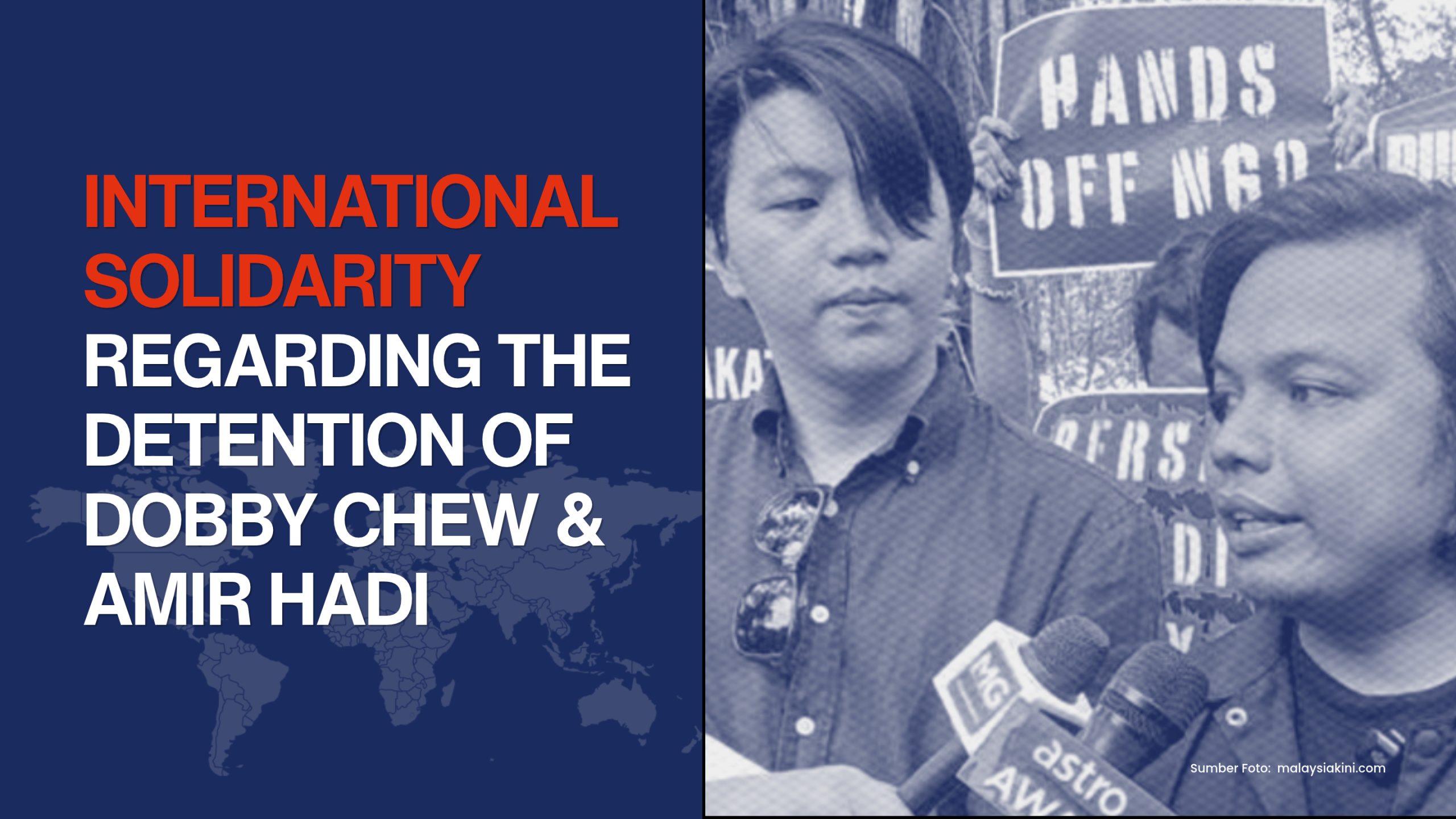
The undersigned civil society organisations and human rights advocates strongly condemn the detention of Dobby Chew and Amir Hadi, Executive Directors of the organisations HAYAT and MANDIRI. The series of events unfolding since May 2026, leading up to their detention on September 22, 2026, reflects an escalating assault on human rights work and raises grave concerns about the erosion of democratic space and the safety of Human Rights Defenders. Both Dobby Chew and Amir Hadi have been remanded in custody until September 25, 2026.
Chronology of Events
Since May 2026, MANDIRI has been targeted by a series of false and misleading claims circulated on social media by individuals commonly referred to as “cybertroopers.” Many of the videos, which were AI-generated, accused MANDIRI of receiving tens of millions of ringgit in foreign funding to incite hatred towards the current administration under Prime Minister Anwar Ibrahim.
The allegations were subsequently amplified by Muhammad Kamil Abdul Munim, Political Secretary to Prime Minister Anwar Ibrahim, who called for the government to invoke the Anti-Money Laundering, Anti-Terrorism Financing and Proceeds of Unlawful Activities Act (AMLA) to investigate these suspicions.
Since these accusations emerged, the Executive Directors of HAYAT and MANDIRI have consistently denied any misuse of public funds to destabilise the government. Like many civil society organisations, they receive legitimate funding to run programs aimed at advancing human rights, promoting policy reforms and covering essential institutional operational costs. They have also repeatedly expressed their willingness to cooperate fully with law enforcement authorities.
In early September 2026, the Malaysian government imposed a travel ban on Dobby Chew and Amir Hadi, preventing them from leaving the country. Subsequently, on September 10, 2026, the government froze the bank accounts of both MANDIRI and HAYAT, as well as the personal bank accounts of Dobby Chew and Amir Hadi, without formal notice or explanation.
On September 21, 2026, the police officially summoned Dobby Chew and Amir Hadi for questioning the following day. On September 22, both of them appeared for an interrogation process that lasted approximately two hours before they were formally arrested for further investigation under Section 4(1) of AMLA, with no indication of any predicate offences. If convicted under the relevant provisions, both Dobby Chew and Amir Hadi could face a sentence of up to 15 years’ imprisonment and a fine of five times the value of the “unlawful activity” or 5 million ringgit, whichever is higher.
As of September 23, 2026, the latest development is that both Dobby Chew and Amir Hadi have been remanded in custody until September 25, 2026. Their continued detention is deeply concerning and requires urgent attention.
The Work of HAYAT for a rights-based approach to drug policy in Malaysia
To understand the profound implications this accusation can have for drug policy reform in Malaysia, it is essential to look at what HAYAT does. HAYAT is a civil society organisation based in Kuala Lumpur, Malaysia, that advocates for drug policy reform centred on the principle of decarceration, and for the total abolition of the death penalty.
HAYAT provides support and accompaniment to the most vulnerable populations. Malaysia abolished mandatory death sentences in 2023 and initiated resentencing processes for individuals previously condemned to death. However, people deprived of liberty still face deplorable prison conditions post-resentencing, which may lead to serious human rights violations. HAYAT regularly provides paralegal support and conducts welfare checks of people in prison, particularly foreign nationals who have long been estranged from their families.
HAYAT’s accompaniment work has further shed light on the intersection between drug smuggling and human trafficking. HAYAT monitoring indicates drug couriers, many of whom are women, can experience various forms of coercion, threats of violence, or unequal power dynamics that ultimately leave them with little choice but to become involved in narcotics offences. This situation is increasingly recognised by international organisations as a form of human trafficking involving elements of forced criminality — particularly via the adopted CCPCJ Resolution 35/2 alongside the UNTOC TIP working group report published in June 2026.
HAYAT plays a pivotal role in pushing international and regional mechanisms to acknowledge the vulnerabilities of these drug couriers. HAYAT has collaborated with the ASEAN Intergovernmental Commission on Human Rights (AICHR) to develop guidelines for ASEAN member states to ensure the implementation of the principle of non-punishment for drug offenders who are victims of human trafficking, as well as Senior Officials Meeting on Transnational Crime (SOMTC) for the Indicators of Trafficking for Forced Criminality.
HAYAT’s work is vital in driving progressive drug policy reform and serves as a medium to rectify punitive, human rights-violating drug policies prevalent in many Southeast Asian countries. Their work also demonstrates that the death penalty in drug cases is an injustice inflicted upon the most vulnerable.
The freezing of accounts and the detention of HAYAT’s leader have brought crucial case accompaniment work to a standstill, directly disrupting efforts to protect the rights of people affected by punitive drug policies in Malaysia.
Anti-money laundering laws are critical tools for tackling illicit financial flows and serious criminal activity. They must not, however, be instrumentalised to intimidate, criminalise or silence civil society and thereby shrink civic space. The use of AMLA against HAYAT and MANDIRI raises serious concerns that powers intended to address genuine financial crime are instead being deployed against legitimate human rights work. More broadly, the apparent conflation of legitimate drug policy and human rights work with terrorism and other security threats, including through the application of anti-terrorism and Financial Action Task Force (FATF) standards, risks further shrinking civic space and legitimising the criminalisation of civil society activity. It should be noted that FATF standards require legitimate civil society work to be protected. The Malaysian government must not weaponise counter-terrorism and frameworks to address organised criminal activity to target human rights defenders or organisations working on drug policy and harm reduction.
Joint Demands
In light of the above situation, we urge the Malaysian government to:
- Immediately release Dobby Chew and Amir Hadi from detention and disclose the predicate offence that warranted their arrest under Section 4(1) of AMLA.
- Guarantee due process and access to legal counsel, including prompt access to lawyers, information about the allegations and evidence against them, and a fair and transparent judicial process
- Immediately lift the unlawful freezes on the bank accounts of HAYAT, MANDIRI, Amir Hadi and Dobby Chew, and return all other seized assets.
- Immediately lift and remove all travel restrictions imposed on Amir Hadi and Dobby Chew, and ensure that they face no ongoing or future administrative, legal or other measures arising from this case that could restrict their freedom of movement.
- End intimidation and harassment of HAYAT, MANDIRI and other civil society organisations, including online smear campaigns and the dissemination of unsubstantiated allegations by public officials and ensureAnd to make sure that there is a transparent process and a duty to investigate and prosecute, by bringing justice to those found responsible for the violations.
- Ensure that civil society organisations can receive lawful funding, operate independently, and provide legal, humanitarian, and human rights assistance without fear of criminalisation or retaliation.
Signatories:
- AIVL – Australia
- Fédération Addiction – France
- Forum Akar Rumput Indonesia (FARI) – Indonesia
- Forum Droghe – Italy
- Fruity by LoveYourself – Philippines
- GAATW (Global Alliance against Traffic in Women) – Global
- Greater Equitable Measures (GEM) – Malaysia
- Harm Reduction International – Global
- Health Poverty Action – Global
- IMPARSIAL, the Indonesian Human Rights Monitor – Indonesia
- Indonesia Judicial Research Society (IJRS) – Indonesia
- Iniciativa Negra por uma Nova Política sobre Drogas – Brazil
- Institute for Criminal Justice Reform (ICJR) – Indonesia
- Instituto RIA, – México
- International Coalition for Drug Policy Reform and Environmental Justice – Global
- International Drug Policy Consortium (IDPC) – Global
- International Network of People who Use Drugs (INPUD) – Global
- Inti Muda Indonesia – Indonesia
- Jaringan Reformasi Kebijakan Narkotika (JRKN) – Indonesia
- Justice Project Pakistan (JPP) – Pakistan
- Komisi Untuk Orang Hilang dan Korban Tindak Kekerasan (KontraS) – Indonesia
- KUZA TRUST – Kenya
- Lawyers Collective – India
- Lembaga Bantuan Hukum Masyarakat (LBHM) – Indonesia
- MadCollective – Indonesia
- Malaysia East Coast Coalition of Activists (MECCA) – Malaysia
- id – Indonesia
- NoBox – Philippines
- Partenariat pour l’Éducation, la Réinsertion et l’Épanouissement Social (PERLE SOCIALE) – Bénin & France
- Perkumpulan Rumah Cemara – Indonesia
- Pertubuhan Keluarga Kasih – Malaysia
- Prévention Information et Lutte contre le SIDA (PILS) – Mauritius
- Recovering Nepal, Federation of PUD and Drug Service Organizations – Nepal
- Release – UK
- Sebaran Kasih – Malaysia
- org – US
- Students for Sensible Drug Policy International – Global
- Transform Drug Policy Foundation – UK
- Women and Harm Reduction International Network (WHRIN) – Global
- Yayasan Suar Perempuan Lingkar Napza Nusantara (SPINN) – Indonesia
- Youth RISE – Global
- Zimbabwe Civil Liberties and Drug Network – Zimbabwe
